





Construction Lending Standards Just Tightened: What It Means for Borrowers
Banks tightened construction lending standards in the third quarter of 2026, reversing the easing they reported three months earlier. The Federal Reserve’s October Senior Loan Officer Opinion Survey, released November 2, shows a net 15.5% of banks tightened construction standards, against net easing of 3.7% in July.
For a developer, that reversal shows up as lower leverage, more recourse, and a longer path to a term sheet. It rarely shows up as a flat no. It shows up as a deal that takes ten weeks and comes back smaller than you budgeted.
This article explains what the survey said, what tighter standards look like on an actual construction deal, and how to decide between a bank and a private lender for your next build.
Requity Lending is a direct private lender for ground-up construction, fix and flip, DSCR rentals and manufactured housing, and Florida is our home market. We are not neutral about this topic. What follows is the data first, then our view, clearly marked. This article is general information, not financial or legal advice.
What the Survey Said About Construction Lending Standards
The Senior Loan Officer Opinion Survey asks senior loan officers at about 60 domestic banks and 18 US branches of foreign banks how they changed standards, terms and demand over the past three months. The October survey covers the third quarter of 2026.
| CRE loan category | Net percent tightening, October | Net result, July |
|---|---|---|
| Construction and land development | 15.5% tightened | 3.7% eased |
| Multifamily | 8.8% tightened | Eased |
| Nonfarm nonresidential | Tightened | Eased |
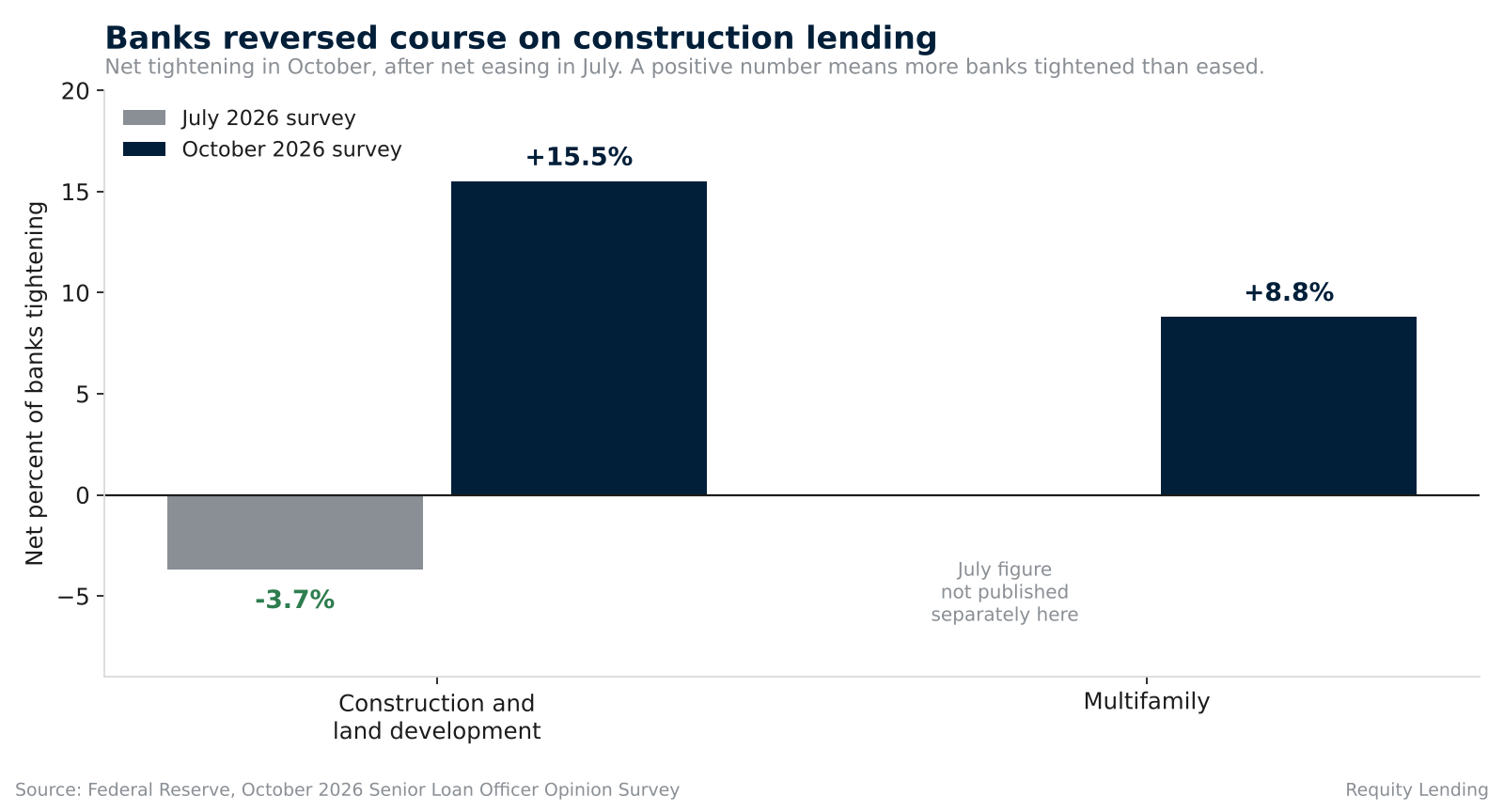
Three findings matter for builders:
- Every CRE category tightened. Banks reported tighter construction lending standards, and tighter standards on nonfarm nonresidential and multifamily loans too. In July, the same survey showed easing.
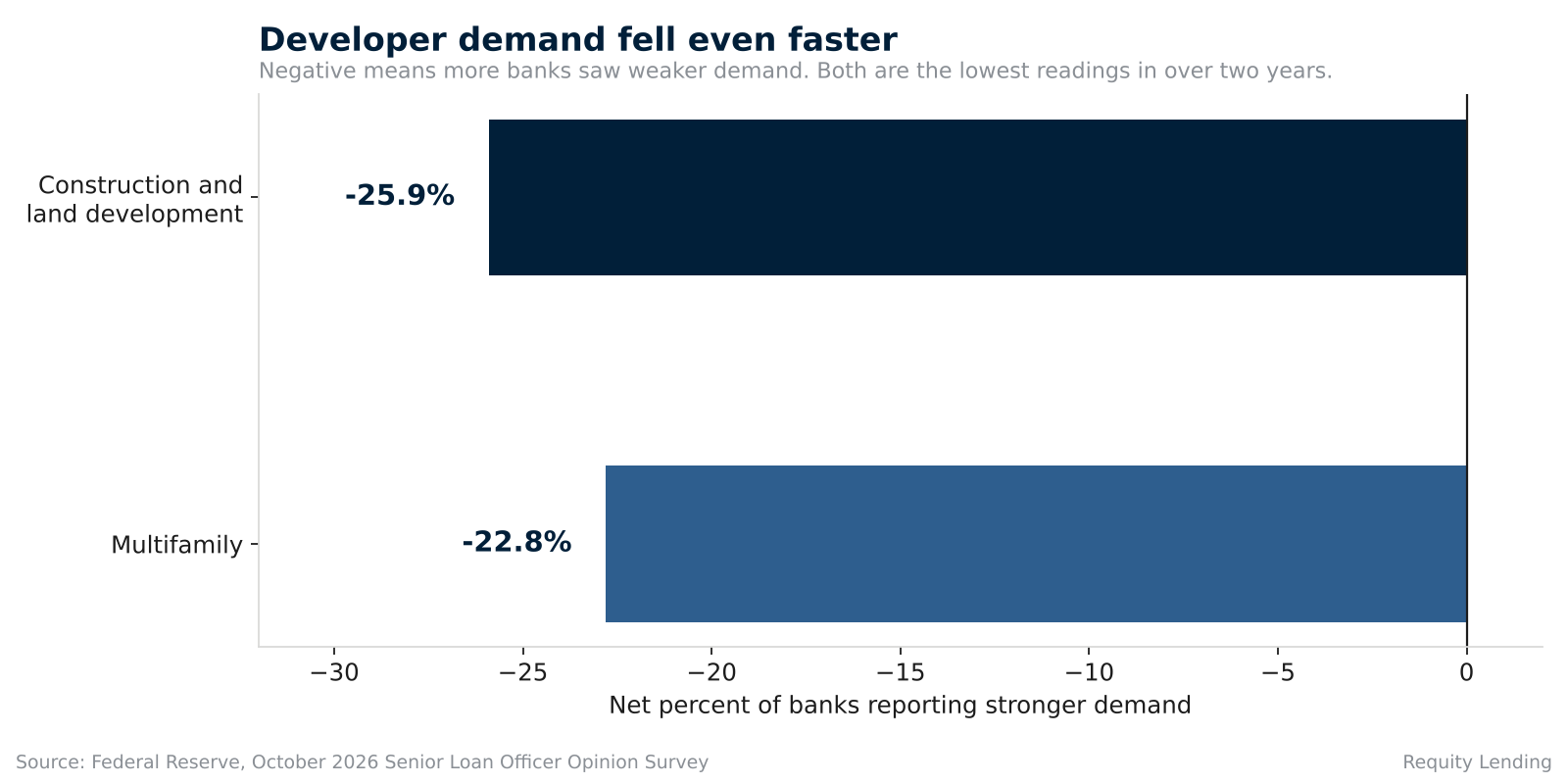
- Demand fell further than standards rose. A net 25.9% of banks reported weaker demand for construction and land development loans, the weakest reading in over two years. Fewer developers are asking, and the ones who ask are meeting a higher bar.
- Private credit got squeezed too. Banks also reported tightening standards on loans to nondepository financial institutions, the category that includes mortgage credit intermediaries and private equity funds. Some private lenders borrow from banks, so this reaches further than it looks.
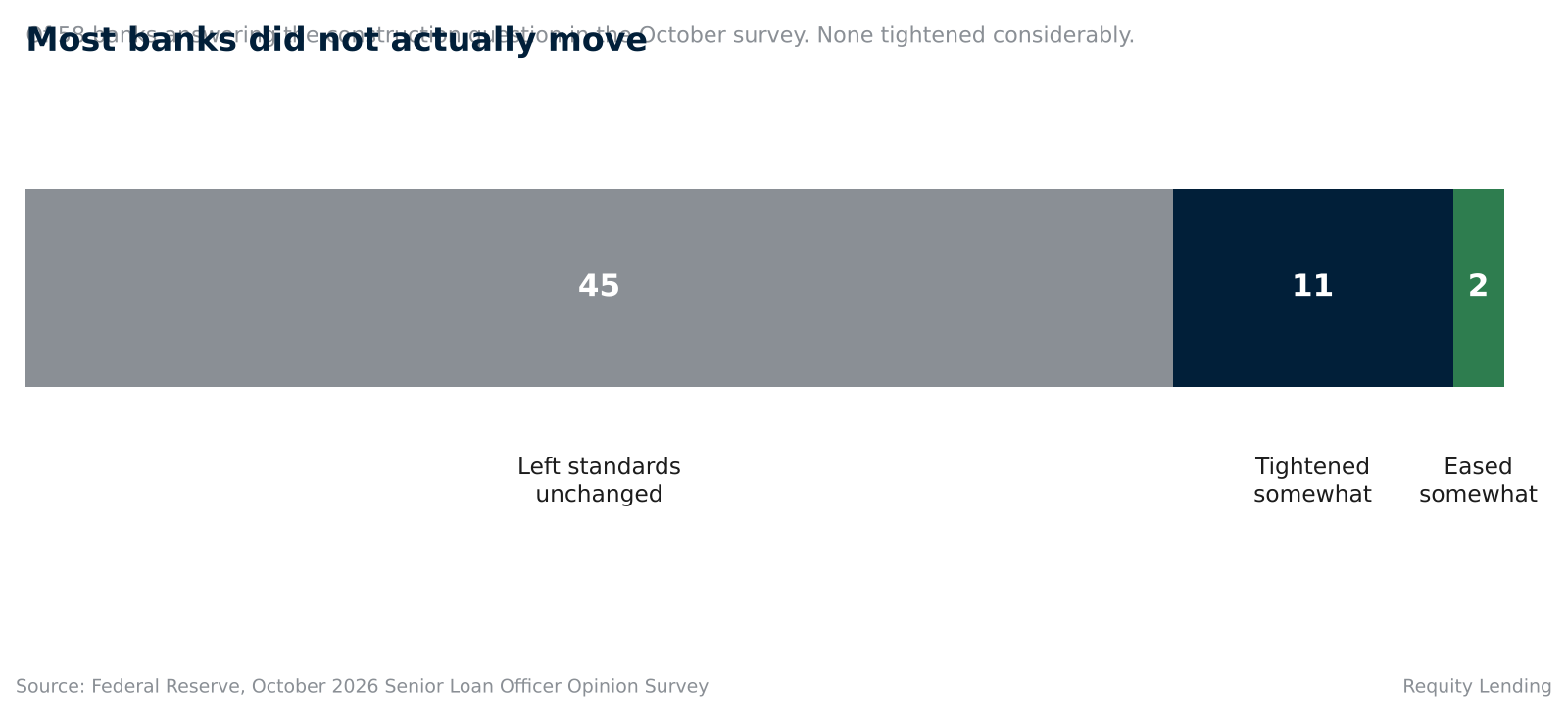
One number deserves context, because it is easy to over-read. Of the 58 banks answering the construction question, 11 tightened somewhat, none tightened considerably, 2 eased, and 45 left standards unchanged. The shift is real and it is the widest net tightening in two years, but most banks did not move. The survey measures what banks say about credit conditions, not how many loans they actually closed.
Why Banks Pulled Back
The Fed attributes the shift to a less favorable or more uncertain economic outlook and to rising industry-specific problems. Underneath that, three structural pressures bear on construction lending in particular:
- Concentration limits. Regulatory guidance flags banks whose construction, land development and other land loans reach 100% or more of total risk-based capital. A bank near that line stops lending on new construction regardless of how good your deal is.
- The maturity wall. Loans written at much lower rates are coming due, and workouts consume the same credit committee attention that new originations need.
- Uncertainty pricing. The Fed noted banks tightened the premiums charged on riskier loans for firms of all sizes. Construction is the riskiest category on most CRE desks, because the collateral does not exist yet.
None of this is about your project. That is the part developers find hardest. A bank can decline a deal that pencils perfectly because of where the bank sits, not where your deal sits.
What Tighter Construction Lending Standards Look Like on Your Deal
Tightening rarely arrives as a rejection. It arrives as changed terms:
- Lower leverage. A project that penciled at 75% of cost comes back at 65%, and you fund the difference.
- More recourse. Full personal guarantees where a partial guarantee would have worked a year ago.
- Deposit relationships. Some banks now want operating accounts moved over as a condition.
- Tighter covenants and more reporting. Interest reserves sized longer, completion guarantees, stricter draw inspections.
- Longer timelines. More committee passes, more conditions, more weeks. In a market where a seller wants certainty, time is the term that costs you the deal.
The practical risk is not that you cannot borrow. It is that you tie up a lot under contract for ten weeks, then discover the loan is $200,000 smaller than you underwrote.
Private Lending vs Bank Loans: How to Decide
Both have a place, and this is the comparison worth running before you commit to a lot. Traditional banks and private lenders underwrite the same project differently, so the answer changes with your timeline and your leverage needs.
A bank weighs your financial history heavily: credit score, credit history, tax returns, global cash flow and the strength of your balance sheet. Loan approval runs through a committee, and the loan application asks for the most documentation. A private lender weighs the project first, then you. Both check credit, but the private lender is usually asking whether the deal services itself and whether you can finish it.
| Factor | Bank construction loan | Private construction loan |
|---|---|---|
| Rate | Lower | Higher interest rates, priced for speed and risk |
| What is underwritten first | Your financial history | The project |
| Leverage in this market | Tightening, often 60% to 70% of cost | Generally higher, set deal by deal |
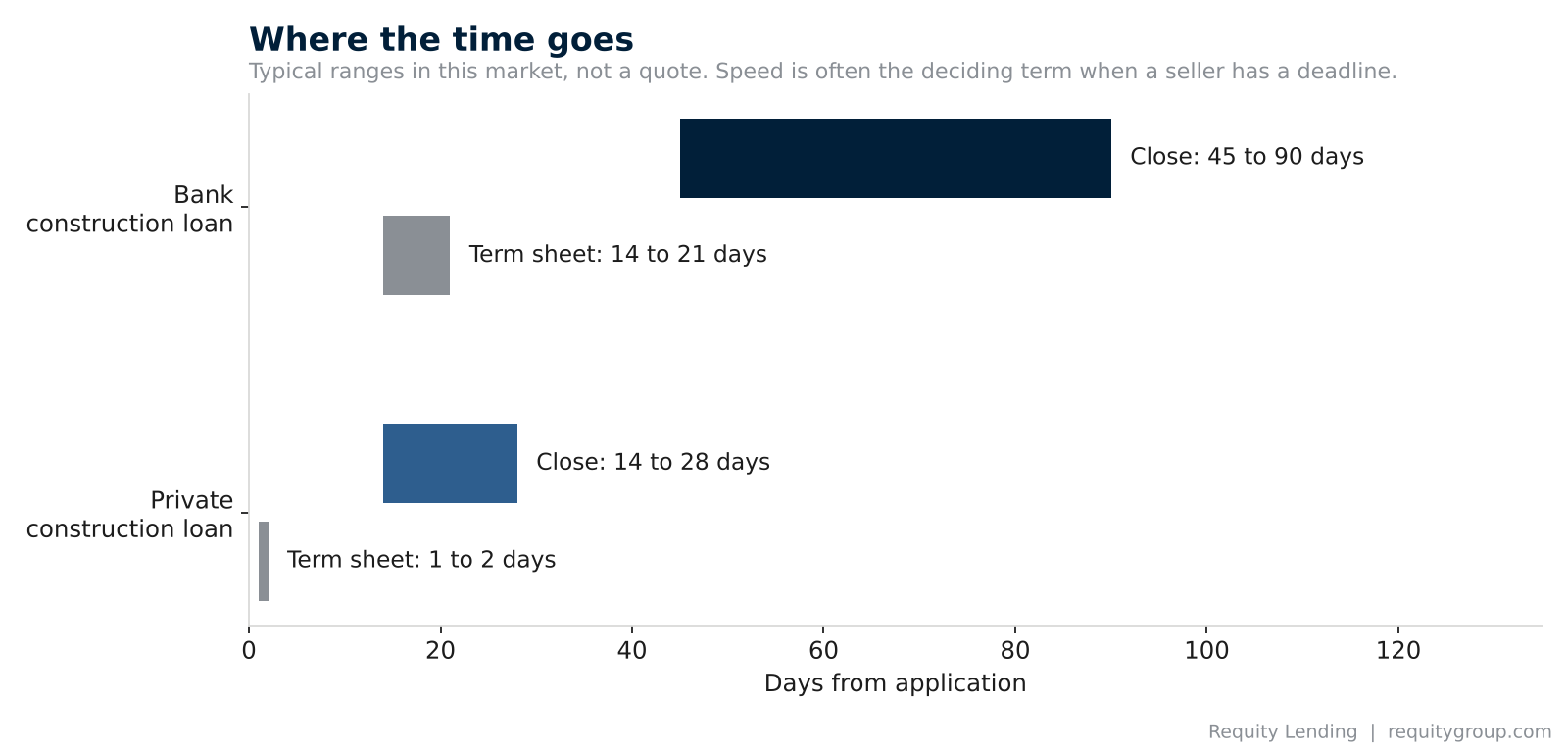
| Speed to term sheet | Weeks | Often 24 to 48 hours |
| Time to close | Typically 45 to 90 days | Typically 2 to 4 weeks |
| Recourse | Usually full | Varies by lender and deal |
| Deposit relationship | Often expected | Not required |
| Experience requirements | Stricter, especially now | We require at least one completed ground-up build in the last 3 years |
| Documentation | Heaviest loan application | Lighter, project-led |
| Best for | Patient capital, strong banking relationship, lowest cost | Speed, certainty, leverage, a seller deadline |
Choose a bank when you have an established relationship, a clean financial history, a flexible timeline, and the rate difference outweighs the execution risk.
Choose a private lender when the deal has a clock on it, when leverage decides whether you can do the project at all, or when you need certainty before you commit earnest money.
Both types of loans finance the same build. The real cost comparison is not rate against rate. It is the rate difference against the carry of a deal you lose, or the equity you tie up because the leverage came in short. Run both.
How to Make Your Deal Financeable Right Now
- Get the lot entitled before you ask. A permitted parcel with utilities confirmed removes the uncertainty lenders are pricing.
- Bring a complete budget with real bids. Line item hard costs by trade, with a 5% to 10% contingency already in the number.
- Document your builder. License, insurance, recent comparable projects and a schedule tied to draw milestones.
- Underwrite the exit with closed comps, not asking prices, and show the lender the same math you used.
- Ask for the term sheet before you go hard. Any lender can quote. The ones worth using will put it in writing quickly.
- Run two processes in parallel. A bank application and a private quote cost you nothing to hold side by side, and the comparison is the point.
The Florida Angle
Florida construction has local variables that tightening makes more expensive to get wrong:
- Impact fees are due at permitting, often five figures on a single-family home, long before your first draw.
- Wind-borne debris requirements add impact-rated glazing or shutters in much of the state, which belongs in the budget rather than as a change order.
- Insurance costs more here, both builder’s risk during the project and the policy your buyer needs at closing.
- Lien exposure. Under Chapter 713 of the Florida Statutes, a subcontractor with no direct contract with you can lien the property. Lenders scrutinize lien paperwork more closely when they are already cautious.
Our guide to ground up construction financing in Florida covers each of these with a worked Tampa budget.
Construction Lending Standards FAQ
What is the Senior Loan Officer Opinion Survey?
It is a quarterly Federal Reserve survey of senior loan officers at roughly 60 domestic banks and 18 US branches of foreign banks, asking how they changed lending standards, terms and loan demand over the past three months. The October 2026 survey was released November 2 and covers the third quarter.
Did banks stop making construction loans?
No. Most banks left standards unchanged. Of the 58 banks answering the construction question, 11 tightened somewhat, 2 eased and 45 reported no change. The net shift was toward tightening, and it was the widest in two years, but construction lending did not stop.
Why does bank tightening matter if I use a private lender?
Two reasons. Tighter bank credit sends more borrowers to private lenders, which lengthens queues at some shops. And banks reported tightening on loans to nondepository financial institutions, which is where some private lenders get their own capital.
How much leverage can I get on a construction loan now?
It depends on the lender, the project and your experience. Banks have moved toward the lower end of their range this quarter. Private construction lenders generally size against total project cost and as-completed value, and set the number deal by deal.
Is a private construction loan worth the higher rate?
Compare total cost, not the rate alone. On a 10-month build, a few points of rate on a drawn balance is often smaller than the cost of losing the deal or funding a larger equity gap. Run both scenarios with your own numbers.
Will construction lending standards loosen again?
The survey is quarterly, and construction lending standards have moved both ways this year: banks reported easing in July and tightening in October. Plan your project on the terms available now rather than on terms you hope to arrive later.
What do lenders scrutinize most in a tight market?
The exit, the budget and the builder. Expect closer review of your comps, firm bids with contingency, your contractor’s license and record, and whether the lot is entitled and permitted.
Does weaker loan demand help borrowers?
Sometimes. Fewer applications can mean more attention from lenders who still have capital to deploy. It also reflects developers pausing projects, which can loosen competition for lots and subcontractors.
Should I wait for rates to fall before I build?
Rate direction is not the only variable. Land price, construction costs, subcontractor availability and the sale price of the finished house all move too. Underwrite the project at today’s terms, stress test a longer timeline, and build if it works on those numbers.
Is private lending more expensive than a bank loan?
On rate, yes. Private loans carry higher interest rates than bank debt, because they price for speed, leverage and a lighter loan application. Whether they cost more overall depends on what the leverage and the timeline are worth on your deal. A project you lose, or an extra $150,000 of equity you have to post, can cost far more than the rate difference over a ten month build.
Does my credit score matter with a private lender?
Yes, though it usually carries less weight than with a bank. Private lenders check credit score and credit history, but they lead with the project: the budget, the exit and the builder. A bank weighs your full financial history more heavily and runs loan approval through a committee.
How fast can a private lender move compared with a bank?
A private lender can often issue a term sheet within a day or two and close in two to four weeks, against roughly 45 to 90 days for a bank construction loan. Speed is usually the deciding factor when a seller has a deadline.
How Requity finances construction
We are a direct lender, which means we hold the decision rather than passing your file to a committee elsewhere.
- Ground-up construction: builds funded on a draw schedule. Up to 85% of total project cost and up to 70% of completed value, $150,000 to $2,500,000, 12 to 24 months, from 11%.
- Fix and flip: up to 90% of total project cost with rehab draws, from 11% fixed.
- DSCR rentals: $100,000 to $3,000,000, up to 80% LTV, qualified on the property’s cash flow.
- Manufactured land-home packages: up to 80% of total cost, with one loan for the land, the home, delivery, installation and site work.
- Term sheets within 24 hours, and we lend in every state except California, Alaska, Hawaii, North Dakota and South Dakota.
See our new construction loans page for current program terms.
What to send us for a quote
- The lot address, purchase price or what you paid, and whether it is permitted
- Your plans and itemized construction budget with bids
- Your builder’s license, insurance and recent projects
- Your construction schedule and target completion date
- Comparable sales or rents supporting the finished value
- Your experience and the entity that will hold title
You do not need every item to start. Send what you have and we will tell you how the project looks.
Financing a Build in a Tighter Market?
Construction lending standards moved against builders this quarter. That does not mean your project is unfinanceable. It means the lender you choose, and how complete your package is, now matter more than they did in July.
Send us the lot and the budget and we will size it with you, often the same day, or call 813.338.1000.
Submit your construction project →
This article is general information as of November 2026 and is not financial, legal or tax advice. Survey figures are from the Federal Reserve’s October 2026 Senior Loan Officer Opinion Survey, released November 2, 2026, and describe what banks reported about the third quarter. Bank terms described above are general market observations, not quotes from any particular institution. Requity Lending makes business-purpose loans secured by non-owner-occupied investment property. Rates, terms, fees and leverage are set deal by deal and subject to underwriting. A term sheet is not a commitment to lend.