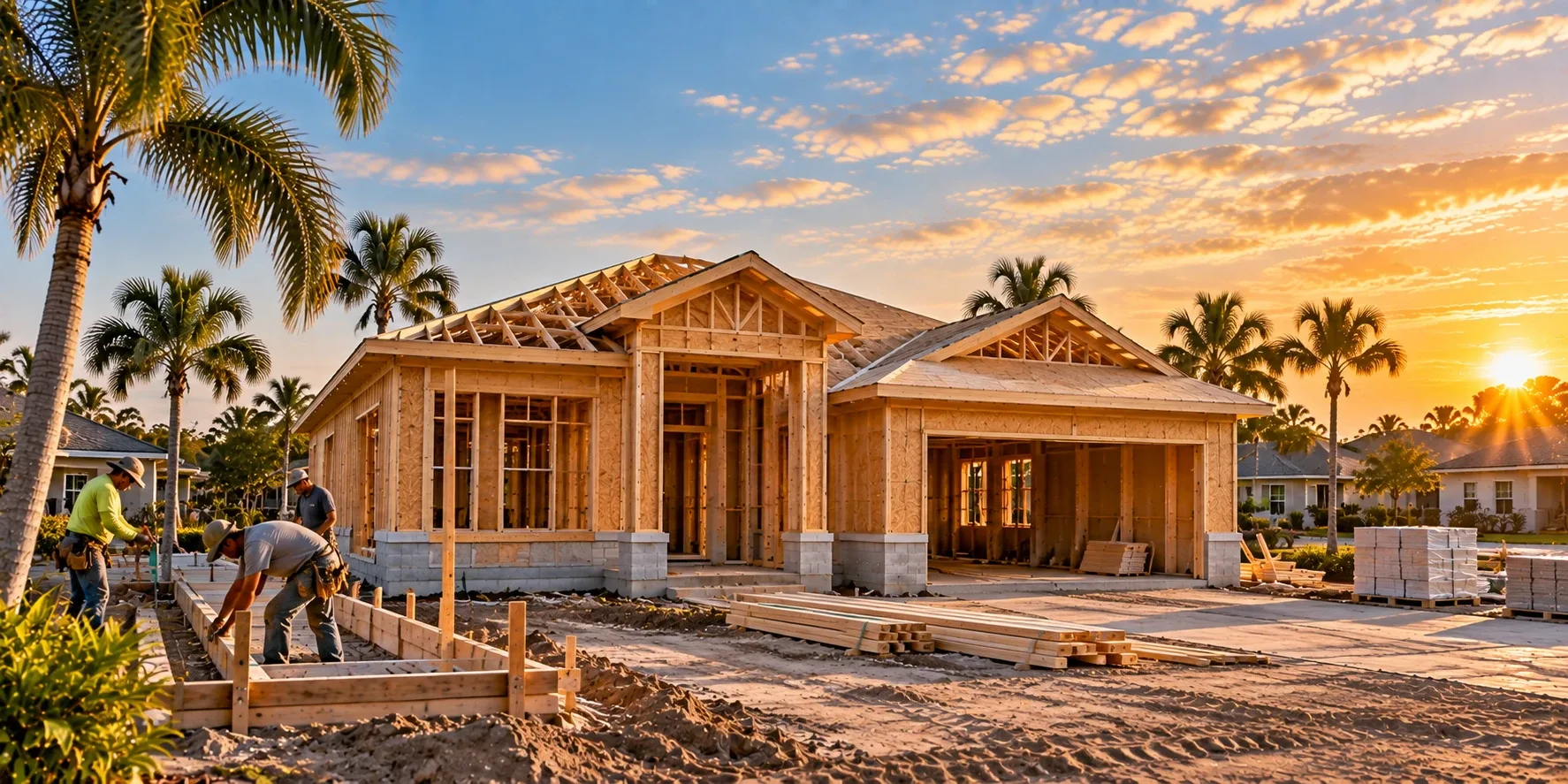
Ground-Up Construction in Florida
Construction loans for Florida investors and builders from a direct lender headquartered in downtown Tampa. One loan for the lot and the build, up to 90% of your total cost, and the construction budget released through draws as each phase is inspected.
Term sheet in 24 hours. No obligation.
No credit pull required. Your information is secure.
$2.5M
Max loan
Up to 90%
Of total cost
Up to 70%
Of completed value
From 10%
Rate
12-24 mo
Term
10 days
Fastest close
Why Requity
Requity is headquartered at 401 E Jackson St in downtown Tampa, and Requity Group owns and operates real estate in Florida. Your build is reviewed by people who know Florida's permitting, wind and flood rules and insurance market, and you can reach them directly at 813.338.1000.
The lot purchase and the full construction budget close together, with one set of documents. Request a draw when a phase is done, a third-party inspector confirms the work, and funds are wired within 2-3 business days.
Your leverage is set by how many ground-up projects you have completed in the last three years. Builders with four or more get up to 90% of total cost. Your term sheet shows exactly where you land.
The Program
The same ground-up program we offer nationally. Leverage depends on the ground-up projects you have completed, sold or refinanced in the last three years.
Rates are fixed and interest-only, with no exit fee. Your loan is the lowest of the cost, lot and completed value limits. Purchase loans shown; refinances run lower. Above 85% of total cost needs an interest reserve. A credit score from 660 to 679 caps the lot advance at 65%, and closing before plans and permits are approved lowers it by 10 points until they are delivered. All loans are subject to underwriting approval. Rates, terms, and fees vary based on property type, loan-to-value ratio, borrower experience, and market conditions. Requity Lending is a commercial bridge lender; we do not offer consumer residential mortgages or owner-occupied construction loans. Contact us for a customized quote.
Local Knowledge
New construction in Florida carries costs and rules that change a project's budget and timeline. These are the ones we see most often.
Florida charges documentary stamp tax on the note at $0.35 per $100 of the loan amount, plus a one-time intangible tax of 0.2% of the loan. On a $600,000 construction loan that is $2,100 in note stamps and $1,200 in intangible tax, paid at closing. The deed on your lot purchase carries its own stamp tax of $0.70 per $100 of the price in most counties (Miami-Dade has different rates).
The Florida Building Code sets wind loads for every new home, and Miami-Dade and Broward sit in the High-Velocity Hurricane Zone, with stricter product approvals for windows, doors and roofing. Impact-rated openings or shutters, roof-to-wall connections and roof covering add real cost, so price them into your budget from the plans, not from a national average.
In a FEMA Special Flood Hazard Area the lowest floor has to be built at or above the base flood elevation, and many Florida counties and cities add extra freeboard on top. That can mean fill, a stem wall or a raised foundation. Get an elevation certificate, confirm the local freeboard rule and price flood insurance before you set your sale price or rent.
Florida counties and many cities charge impact fees for roads, schools, parks and utilities when the building permit is issued, and they can run into five figures per home. Water and sewer connection fees come on top. On a lot without sewer, a septic permit comes from the Florida Department of Environmental Protection, and soil and setback rules can shape what you can build.
Florida's owner-builder exemption is meant for owners building a home for their own use. It does not cover a house you plan to sell or rent, and selling within a year of completion creates a presumption that it was built for sale. Use a Florida-licensed general contractor for a spec or rental build, and keep the license and contract in your loan file.
Most improvement jobs over $2,500 need a recorded Notice of Commencement before work starts. Under Florida's construction lien law, unpaid contractors and suppliers can lien the property, so collect a lien release with every payment. Our draws work the same way: we ask for lien releases from anyone owed more than $1,000.
Hurricane season runs from June 1 to November 30. Carry a builder's risk policy from the start of work, get the house dried in early, and know that insurers usually stop binding new policies while a named storm threatens your area. Florida also allows licensed private providers to handle plan review and inspections, which some builders use to keep a schedule on track.

How It Works
01
Share the address, lot price, plans, line-item budget and your list of completed builds. You get a term sheet within 24 hours, with no credit pull.
02
We order an as-completed appraisal and work with your Florida title company or closing attorney. Bring your LLC documents, your contractor's license and contract, and your permits or a timeline to get them.
03
The lot funds at closing. Timing depends on title, the appraisal and how complete your plans, permits and budget are.
04
Request draws as phases are finished and inspected. When the home sells, the loan is paid off at closing. To keep it as a rental, refinance into a long-term DSCR loan.
FAQ
Don't see your question? Call 813.338.1000 or email contact@requitygroup.com.
Yes. We lend statewide, including Tampa Bay, Orlando, Jacksonville, South Florida, Southwest Florida, Sarasota and Bradenton, Lakeland, Ocala and the Panhandle. Every project is underwritten on the local market, the plans and budget, and comparable sales of new homes nearby.
No. We lend only on investment properties closed in an LLC or corporation: homes built to sell or to rent. If you are building a house to live in, you are looking for an owner-occupied construction-to-permanent loan, which banks and credit unions offer.
Yes. You need at least one ground-up project completed in the last three years that you sold or refinanced. Work as a licensed general contractor on someone else's build counts as half a project, and fix and flips and rentals do not count. With one project you also need a 700 credit score. With two or more, the minimum is 660.
Rates start at 10% fixed and interest-only, with origination from 1 point ($3,000 minimum) and a $2,950 legal and documentation fee. There is no exit fee. Florida adds two loan taxes at closing: documentary stamp tax on the note ($0.35 per $100 of the loan) and intangible tax (0.2% of the loan).
From $150,000 to $2,500,000. Depending on your completed projects, we lend up to 80% to 90% of the total project cost (lot plus construction budget) and up to 65% to 70% of the appraised completed value. The construction budget is released through draws as phases are completed and inspected.
No. You can get a term sheet with preliminary plans and a budget. If you close before your plans and permits are approved, the amount funded on the lot at closing is 10 points lower until you deliver them. The land must already be entitled for what you plan to build.
Only if you hold a Florida contractor's license. Florida's owner-builder exemption covers a home built for your own use, not one built to sell or rent. Larger budgets need a general contractor, and your contractor's license and contract are part of the loan file.
Yes. Flood zones are common across Florida and are not a deal breaker. The home must be built to the base flood elevation plus any local freeboard, flood insurance will be required in a FEMA Special Flood Hazard Area, and both belong in your budget and your sale price.
Single-family homes, townhomes, and duplexes to fourplexes, built as investment properties. Each home must be on its own tax parcel and the land held in fee simple. For a manufactured home placed on land, see our land-home package loans.
Yes. We lend to LLCs and corporations, not individuals. If your entity was formed in another state, it will generally need to register with the Florida Division of Corporations (Sunbiz) as a foreign entity. We confirm this before closing.