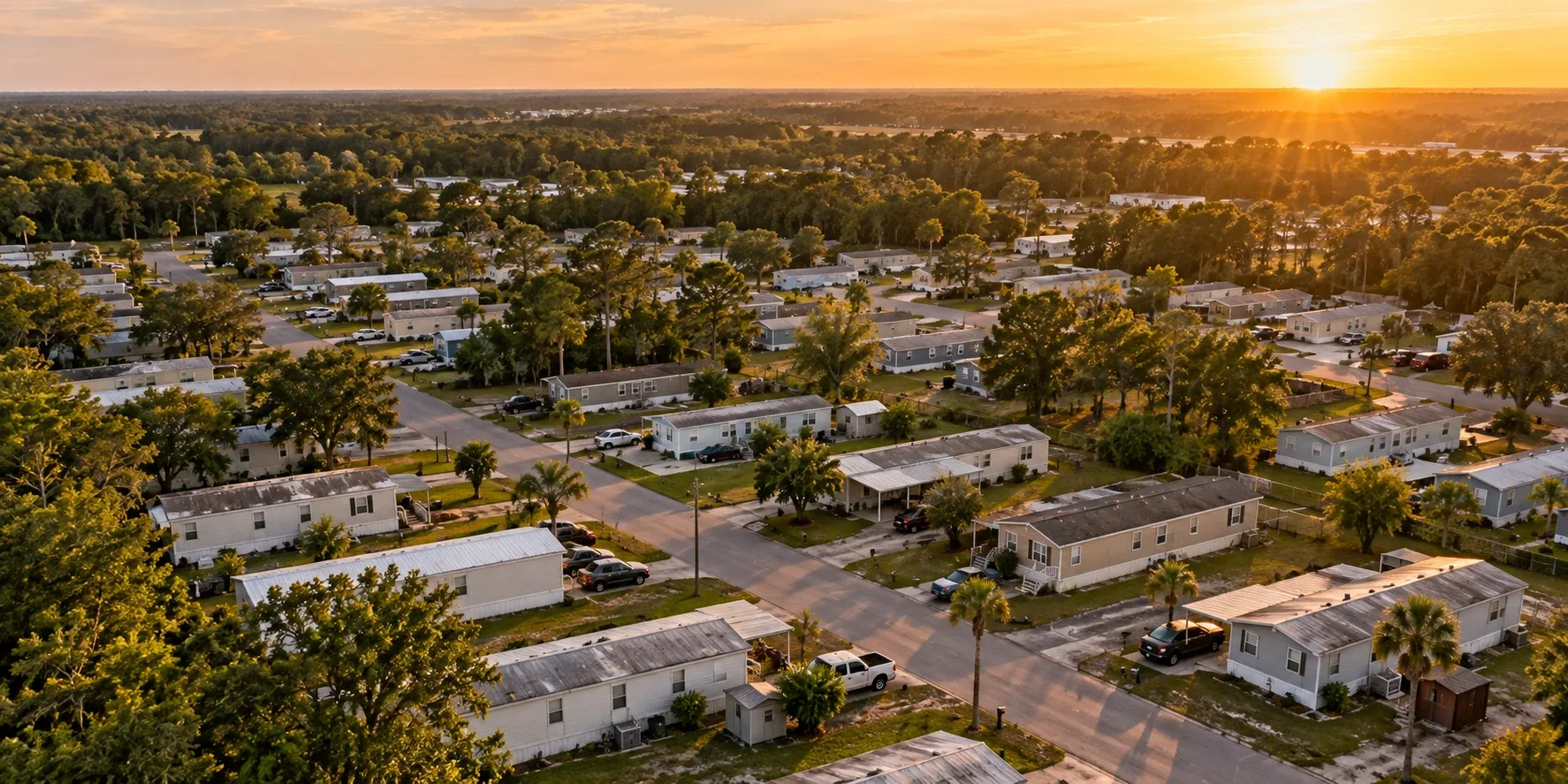
Aerial view of a manufactured housing community at sunset

Invest › Syndications › Manufactured Housing

Asset Class

Manufactured Housing Communities

Affordable housing with recession-resilient demand, low tenant turnover, and significant lot rent upside in value-add communities.

Request investor access

Share a few details and our investor relations team will follow up with current offerings.

Thank you. Our investor relations team will be in touch shortly.

Investment Thesis

America's largest source of affordable housing

Overview

Over 22 million Americans live in manufactured housing communities, commonly known as mobile home parks. It is the only large-scale form of unsubsidized affordable housing in the country, and demand is growing as traditional housing costs continue to rise. For investors, MHCs offer a combination of characteristics that are difficult to find in other real estate asset classes.

Rent and turnover

Lot rents remain a fraction of apartment rents in the same markets, creating room for sustained, responsible rent growth. Because residents own their homes and have significant equity at stake, turnover rates are typically under 5% annually, compared to 40-60% in conventional apartments. Lower turnover means lower operating costs and more predictable cash flow.

Constrained supply

New supply is severely constrained. Zoning restrictions and community opposition make it nearly impossible to build new mobile home parks, which means existing manufactured housing communities are an irreplaceable asset with a natural barrier to competition.

By the Numbers

Why this asset class

22M+

Americans in manufactured housing

<5%

Annual tenant turnover (vs. 40-60% apartments)

~0

New MHC communities built annually due to zoning

Value-Add Playbook

How we create value

01

Lot Rent Optimization

Many MHCs charge lot rents well below market. We implement responsible, phased rent increases that bring rents to market level over the hold period, directly increasing NOI and property value.

02

Infrastructure Upgrades

Roads, water systems, sewer lines, electrical panels, and common areas. Capital improvements increase property value, reduce maintenance costs, and justify market rents.

03

Home Infill

Vacant lots generate zero revenue. We purchase new or used manufactured homes and place them on empty lots, converting idle land into income-producing assets at attractive returns on investment.

04

Utility Submetering

Shifting water, sewer, and electric costs from the park to individual residents through submetering reduces operating expenses and creates immediate NOI improvement.

05

Professional Management

Many MHCs are acquired from mom-and-pop operators with informal systems. We implement professional property management, accounting, and resident communication from day one.

06

Community Standards

Enforcing community rules, improving curb appeal, and maintaining common areas increases resident satisfaction, reduces turnover, and supports premium positioning in the local market.

Sample Investment Profile

What $100,000 could look like

The following is a hypothetical illustration, not an actual offering or guarantee of returns. Actual results will vary.

Your investment
Closing day, Year 0 $100,000
Targeted annual cash flow
Year 1: Pre-stabilization, early value-add phase $6,000 (6% CoC)
Year 2: Lot rent increases and infill coming online $7,000 (7% CoC)
Year 3: Submetering and occupancy gains $8,000 (8% CoC)
Year 4: Near-stabilized operations $9,000 (9% CoC)
Year 5: Stabilized, exit preparation $10,000 (10% CoC)
Total Distributions (Yrs 1-5) $40,000
Year 5 exit
Return of Capital: your original investment returned at sale $100,000
Sale Proceeds (your share): profit from property appreciation at exit $60,000
Total Return: distributions + return of capital + sale proceeds $200,000 (2.0X Equity Multiple)

This illustration is for educational purposes only and does not represent an actual or projected investment. Targeted returns are not guaranteed. Actual results will differ materially. Past performance is not indicative of future results. Distributions are targeted, not guaranteed, and may vary.

Our Experience

We operate what we invest in

Our experience

Requity Group is not a first-time MHC investor. We manage manufactured housing communities (mobile home parks) in our own portfolio and have originated dozens of bridge loans to MHC operators across the Southeast. We know the asset class from the lending side, the ownership side, and the operations side.

Our edge

This vertical integration gives us an edge in underwriting, due diligence, and execution. When we evaluate an MHC acquisition, we are not relying on pro forma assumptions. We are comparing the opportunity against communities we already run.

Track Record

Our experience in numbers

4,000+

Units Managed

34%

Of Loan Portfolio in MHC

0%

Principal Loss in MHC Lending

9+

Properties Operated

FAQ

Manufactured housing questions

Don't see your question? Call 813.338.1000 or email contact@requitygroup.com.

What is a manufactured housing community?

A manufactured housing community (MHC) is a property where the operator owns the land and infrastructure (roads, utilities, common areas) and residents either own or rent manufactured homes placed on individual lots. The primary revenue comes from lot rent, which is the fee residents pay for the right to keep their home on the land. This is sometimes called a mobile home park, though modern MHCs are significantly more sophisticated.

Why is MHC considered recession-resilient?

Manufactured housing is the largest source of unsubsidized affordable housing in the United States. Average lot rents are a fraction of apartment rents, making MHC the last stop before homelessness for many residents. Demand increases during recessions as people downsize from more expensive housing. Additionally, because residents own their homes and would lose significant equity by moving, tenant turnover is extremely low compared to apartments.

How does Requity Group increase value in MHC investments?

We focus on communities with below-market lot rents, deferred maintenance, vacant lots, and operational inefficiencies. Our value-add strategy includes bringing lot rents to market rates over time, improving infrastructure (roads, water, sewer, electrical), filling vacant lots with new or used homes, submetering utilities to reduce operating expenses, and implementing professional property management. Each of these levers directly increases net operating income.

What is the typical hold period for an MHC syndication?

Our target hold period is 3-5 years, which provides enough time to execute the value-add business plan, stabilize the property, and exit at a valuation that reflects the improved income. We evaluate exit opportunities continuously and will transact when the returns justify it.

What are the risks specific to MHC investing?

Key risks include regulatory changes affecting rent increases or zoning, infrastructure failure (aging water and sewer systems can be expensive to replace), difficulty filling vacant lots in certain markets, environmental liabilities, and concentration risk in affordable housing. We mitigate these through thorough due diligence, conservative underwriting, infrastructure inspections, phase I environmental assessments, and market research before every acquisition.

Disclosures

Important Information

Important Disclosures

Requity Group LLC is not registered as an investment adviser. Interests in individual syndications are offered under separate offering memoranda pursuant to Regulation D and have not been registered under the Securities Act of 1933. Syndication investments are speculative, illiquid, and involve risk of loss including total loss of capital. Target returns and illustrative economics are not guaranteed. Past performance is not indicative of future results. Consult your tax, legal, and financial advisors before investing.